


Introduction
A PhD is a marathon, yet most scholars start it without a map. You juggle coursework, a busy supervisor, a job and often a family. Meanwhile, the submission deadline keeps moving closer. This is exactly where PhD guidance services earn their place. They give you a clear roadmap, an expert sounding board and hands-on help with the hardest parts of research.
However, not every provider is equal. Some offer genuine mentoring. Others sell ready-made theses, which can end an academic career. In this guide, you will learn what these services include, what they cost, how to judge quality and how to use them ethically. We also share how the mentoring team at PhDiZone structures support for scholars across India.
What Are PhD Guidance Services?
PhD guidance services are structured, fee-based programmes in which experienced researchers mentor doctoral candidates through each stage of the PhD. They support your university supervisor rather than replace them. In short, they help you do your own work better and faster.
At a glance: PhD guidance services
What it is: Expert mentoring and research support for doctoral scholars.
Who provides it: PhD-qualified subject experts, statisticians and academic editors.
What it covers: Topic selection, synopsis, literature review, methodology, data analysis, editing, publication and viva preparation.
What it is not: Ghostwriting, selling a thesis or fabricating data.
Related terms: PhD research guidance, PhD consultation services, PhD research support services.
Most scholars use these services in one of two ways. First, some choose end-to-end mentoring from enrolment to viva. Second, others book one-off PhD consultation services for a single roadblock, such as SPSS analysis or a journal rejection.
Why Do Scholars Need PhD Research Guidance?
Scholars seek PhD research guidance because doctoral programmes have high dropout rates, limited supervisor time and steep technical demands. Expert support cuts delays at the exact stages where most candidates get stuck.
The numbers explain the demand:
- The Council of Graduate Schools PhD Completion Project found that only about 57% of US doctoral candidates completed within 10 years.
- A 2019 Nature survey of more than 6,300 graduate students found that 36% had sought help for anxiety or depression caused by their PhD.
- India’s AISHE 2021–22 report counts more than 2.1 lakh PhD enrolments, yet supervisor capacity has not kept pace.
The supervisor gap
A supervisor often guides six to eight scholars alongside teaching and administration. As a result, many scholars get less than an hour of focused feedback each month. That is rarely enough to fix a weak methodology chapter.
The skills gap
Most programmes assume you already know statistics, qualitative coding, reference managers and academic English. In reality, scholars learn these on the fly. Consequently, small technical gaps turn into months of delay.
What Do PhD Thesis Guidance Services Include?
Most PhD thesis guidance services cover seven stages, from topic selection to the viva. Good providers let you buy each stage separately, so you pay only for the help you need.
Topic selection and synopsis
A mentor helps you test topic ideas for novelty, feasibility and data access. Then, you draft a synopsis that your research committee can approve quickly.
Literature review and gap analysis
You learn to search Scopus, Web of Science and Shodhganga systematically. After that, the mentor reviews your synthesis and checks that your research gap is real and clearly stated.
Research methodology and design
This is where many theses struggle at review. A methodologist checks your sampling, instruments, variables and ethics approval before you collect any data.
Data analysis
Statisticians guide you through SPSS, R, AMOS, SmartPLS or NVivo. Crucially, they explain every output so you can defend it in your viva.
Thesis review, editing and plagiarism check
Editors review structure, argument flow, language and referencing. They also run a similarity check and show you how to fix any flagged passages yourself.
Publication and viva preparation
Mentors help you pick indexed journals, respond to reviewers and avoid predatory publishers. Finally, mock vivas prepare you for the toughest examiner questions.
How Do PhD Guidance Services Help You Finish Faster?
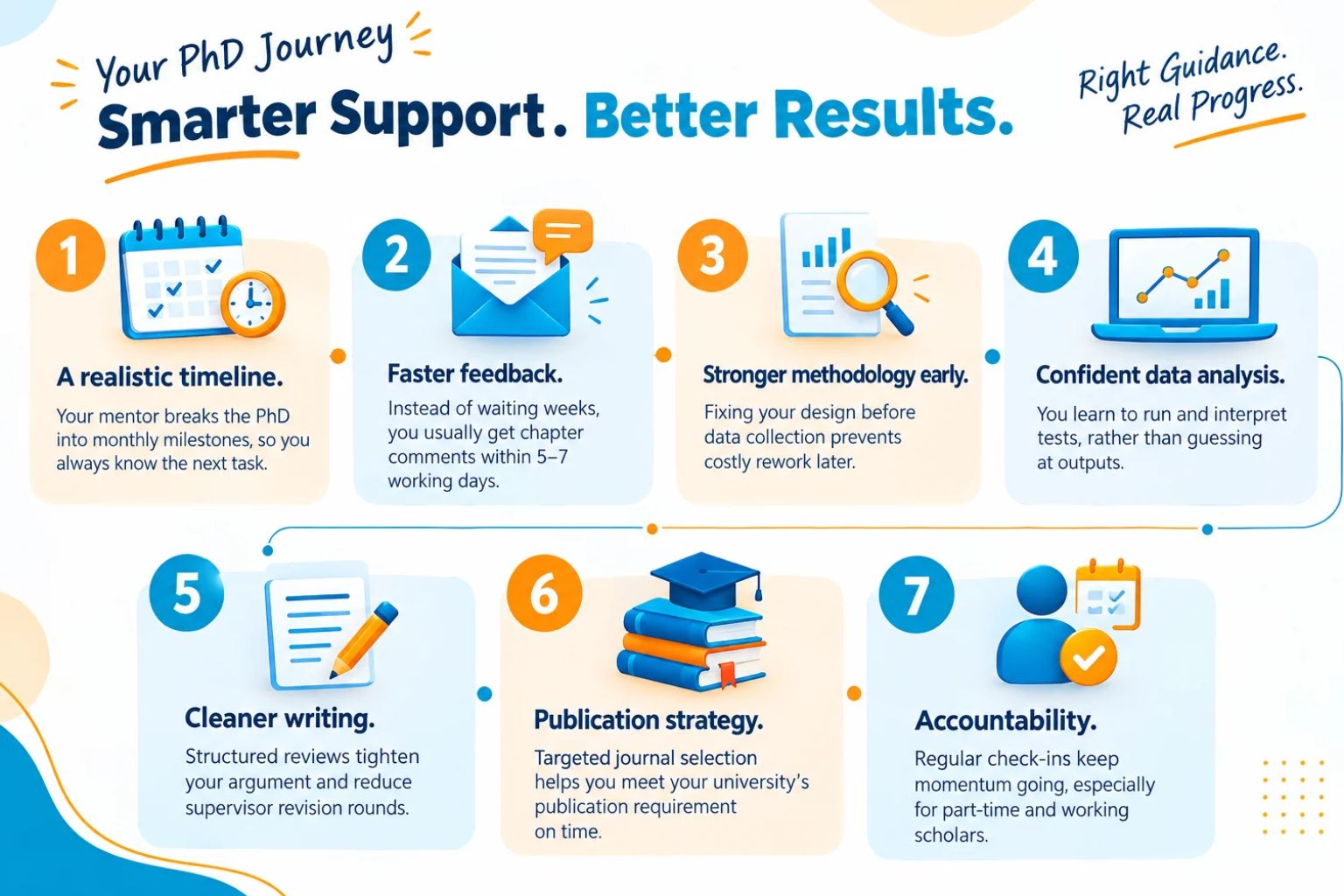
PhD guidance services speed up completion by removing the bottlenecks that cause most delays. Here are seven proven ways they help.
PhD Guidance Services vs Supervisor vs Going Solo: What's the Difference?
A supervisor directs and approves your research, a guidance service adds technical depth and time, and going solo relies entirely on self-study. The best results usually come from pairing your supervisor with targeted PhD research support services.
| Factor | University supervisor | PhD guidance service | Going solo |
|---|---|---|---|
| Main role | Academic direction and formal approval | Mentoring, technical help and reviews | Self-directed learning |
| Time available | Limited, shared across scholars | Scheduled, dedicated sessions | Unlimited, but unguided |
| Statistics and software depth | Varies by supervisor | Specialist statisticians | Online tutorials only |
| Cost | Included in university fees | ₹5,000-₹2,50,000 by scope | Free, but slow |
| Feedback speed | Weeks to months | Typically 5-7 working days | None |
| Authority over thesis | Final say | Advisory only | None |
How Much Do PhD Consultation Services Cost in India?
PhD consultation services in India usually cost ₹5,000-₹25,000 for a single stage and ₹40,000-₹2,50,000 for full mentoring. Price depends on your subject, the stage you need, turnaround time and the mentor’s seniority.
| Service | Typical scope | Indicative price (INR) |
|---|---|---|
| One-off consultation | 60–90 minute expert session | ₹2,000-₹5,000 |
| Topic and synopsis guidance | Topic shortlist, synopsis review, 2 revision rounds | ₹8,000-₹20,000 |
| Methodology and data analysis | Design review, analysis coaching, results interpretation | ₹15,000-₹60,000 |
| Thesis review and editing | Chapter-wise feedback, language edit, similarity report | ₹20,000-₹75,000 |
| End-to-end PhD mentoring | Enrolment to viva, monthly sessions | ₹40,000-₹2,50,000 |
As a rule, be wary of prices far below these ranges. Extremely cheap offers often mean recycled content, unqualified mentors or hidden ghostwriting. For a deeper breakdown, see our PhD guidance fees guide.
How Do You Find Reliable PhD Guidance Services Near Me?
To find reliable PhD guidance services near me, shortlist providers with verifiable PhD-qualified mentors, then test them with a paid trial session. Local or online, the vetting steps are the same.
- Search with intent. Use terms like “PhD guidance services near me” plus your city and subject, and note who ranks with real reviews.
- Verify the mentors. Ask for names, PhD institutions, Google Scholar profiles and subject match.
- Request sample feedback. A good provider shows anonymised comments on a real chapter, not a finished thesis.
- Read the ethics policy. It should state clearly that you write your own thesis and own your data.
- Check the contract. Look for milestones, revision limits, confidentiality terms and a refund clause.
- Start small. Book one consultation before committing to a full package.
Online mentoring works well for most stages. However, in-person sessions can help with lab work, fieldwork planning or viva rehearsal.
Is Using PhD Guidance Services Ethical?
Yes, using PhD guidance services is ethical when the scholar does the research and writing, and the service only teaches, reviews and advises. It becomes misconduct when someone else writes your thesis, invents data or hides plagiarism.
In India, the UGC (Promotion of Academic Integrity and Prevention of Plagiarism in Higher Educational Institutions) Regulations, 2018 set clear penalties for plagiarism in theses. Above 10% similarity, consequences escalate from revision to withdrawal of the degree. Therefore, a trustworthy provider protects your integrity as much as your timeline.
For this reason, PhDiZone follows a simple rule: mentors explain and review, while scholars write and decide. You can read the full approach in our academic integrity policy.
Worked Example: From Stalled Synopsis to Submitted Thesis
Here is an illustrative case of how structured PhD research guidance changes outcomes. A part-time management scholar in Pune had her synopsis returned twice over 14 months.
- Month 1: A mentor reframed her research gap and replaced a vague survey with a validated instrument.
- Month 2: The committee approved her revised synopsis on the first review.
- Months 3–9: She collected 412 responses and learned structural equation modelling in SmartPLS with a statistician.
- Months 10–16: Chapter-wise reviews reduced her supervisor’s revision rounds from four to two per chapter.
- Month 18: She submitted her thesis at a 6% similarity index, with two Scopus-indexed papers published.
In total, she finished roughly a year ahead of her own revised plan. Most importantly, she wrote every chapter herself, so she defended her methods with confidence.
Common Mistakes to Avoid
Most bad experiences with PhD guidance services come from a few avoidable mistakes. Watch for these before you sign up.
- Buying a “complete thesis”. It breaches UGC rules and can cost you your degree.
- Choosing on price alone. Cheap packages often hide unqualified mentors or recycled work.
- Hiding the support from your supervisor. Transparency builds trust and avoids conflicting advice.
- Skipping the contract. Without clear milestones, revisions and refunds become disputes.
- Outsourcing understanding. If you cannot explain your analysis, your viva will expose it.
- Ignoring data ownership. Make sure your raw data and drafts stay yours and remain confidential.
Conclusion
PhD guidance services work best as a partner, not a shortcut. Used well, they sharpen your methodology, speed up feedback and build the skills you need to defend your work. Used badly, they put your degree at risk.
So, choose mentors you can verify, insist on an ethics-first contract and stay the author of your own research. If you want a structured, transparent starting point, book a free 20-minute consultation with PhDiZone and get a stage-by-stage plan for your PhD.
Frequently Asked Questions
What is the difference between PhD guidance and PhD ghostwriting?
PhD guidance means an expert teaches, reviews and advises while you do the research and writing yourself. Ghostwriting means someone else writes your thesis, which breaches UGC plagiarism regulations and university rules. Ethical PhD guidance services build your skills, so you can explain and defend every chapter in your viva.
Can I use PhD guidance services if I already have a supervisor?
Yes. Most scholars who use PhD guidance services already have a supervisor. The service adds technical depth, faster feedback and accountability, while your supervisor keeps academic authority and final approval. It helps to tell your supervisor, so advice stays consistent and your research direction never gets pulled two ways.
How long does PhD thesis guidance usually take?
It depends on your stage and scope. A synopsis package usually takes four to eight weeks, and data analysis support takes one to three months. End-to-end PhD thesis guidance services typically run 18 to 36 months, aligned with your university’s minimum duration and your own pace of writing.
Are online PhD guidance services as effective as local ones?
For most stages, yes. Synopsis review, literature review, data analysis coaching and editing work well through video calls and shared documents. However, a provider offering PhD guidance services near me in person can help more with lab protocols, fieldwork planning and face-to-face mock vivas before your final defence.
What qualifications should a PhD mentor have?
A PhD mentor should hold a doctorate in your subject or a closely related field. Ideally, they also have indexed publications, supervision or reviewing experience and a public profile on Google Scholar or ORCID. Statistics mentors should show hands-on expertise in the exact software your study uses, such as SPSS or R.
Do PhD research support services help with journal publication?
Yes, good PhD research support services help you choose suitable Scopus or Web of Science indexed journals, format manuscripts and respond to reviewer comments. They also help you avoid predatory journals. However, no ethical provider can guarantee acceptance, because editors and peer reviewers make that decision independently.